The Art of Serving God by Alonso De Madrid
What inspired the 'primary' of style?
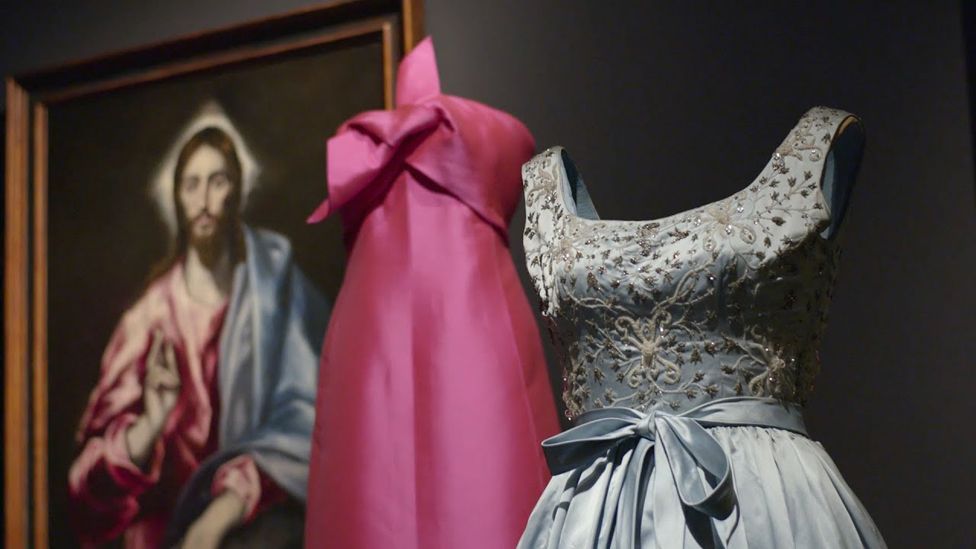
From civilisation to couture, Cath Pound explores how the beautiful art of Spain influenced Balenciaga's stunning, seductive creations.
"He was the primary of the states all," said Christian Dior near the legendary Spanish designer Cristóbal Balenciaga. According to style editor Diana Vreeland, he "brought the manner of Spain into the lives of anybody who wore his designs." Balenciaga constantly referenced Spanish culture and fine art history, reviving historical techniques and styles – and reinterpreting them into such masterfully modern creations that his contemporaries bowed down in awe.
More like this:
- The designer who freed the female body
- The dazzling jewellery of the East
- What does it mean to be camp?
The aesthetic of the Habsburg court can be seen in the velvety blacks and rich embroideries of Balenciaga'southward eveningwear. His chromatic boldness comes from the palette of El Greco, sure silhouettes from the canvases of Velázquez. The pure shapes and forms that earned him the nickname 'the architect of haute couture,' have their origins in the vestments of Zurbarán'due south saints and friars. Earthier influences from flamenco and bullfighting are transformed into elegant cocktail gowns and boleros.
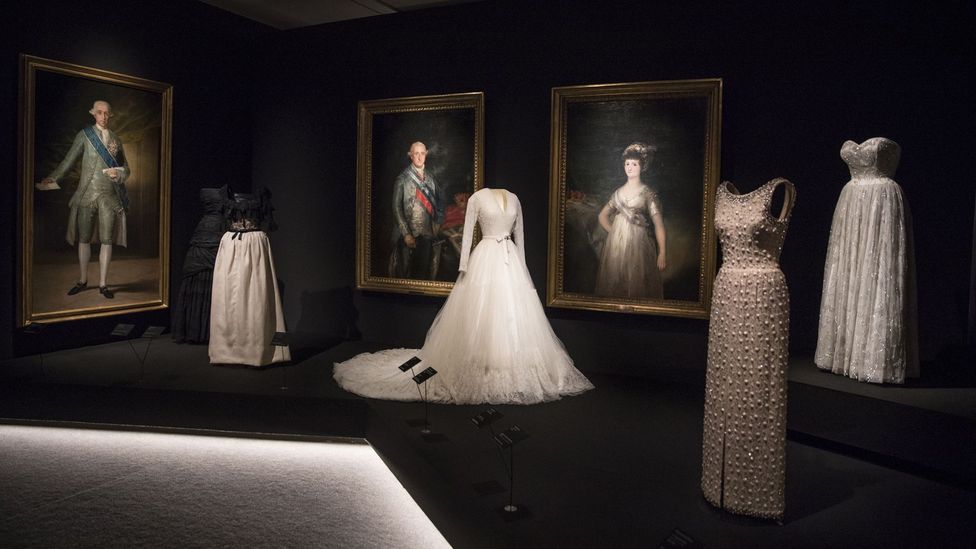
Goya is among the artists who was a huge influence on Balenciaga (Credit: Museo Nacional Thyssen-Bornemisza, Madrid/ Jon Cazenave)
Balenciaga's appreciation for art and way had been shaped at an early age in the habitation of the Marchioness of Casa Torres, where his mother, Martina, worked equally a seamstress. The Marchioness was a supremely elegant adult female who dressed in the very best couture from Charles Frederick Worth, Jeanne Paquin and Jacques Doucet. The family unit also owned 1 of the all-time collections of Spanish art in the country, which included masterpieces by Velázquez, Pantoja de la Cruz, El Greco and Goya.
"When we walk through 400 years of Spanish art nosotros realise that the painters were really passionate nigh mode and paid enormous attention to information technology. That's something Balenciaga realised quite early," says Eloy Martínez de la Pera, curator of Balenciaga and Spanish Painting at the Museo Nacional Thyssen-Bornemisza in Madrid.
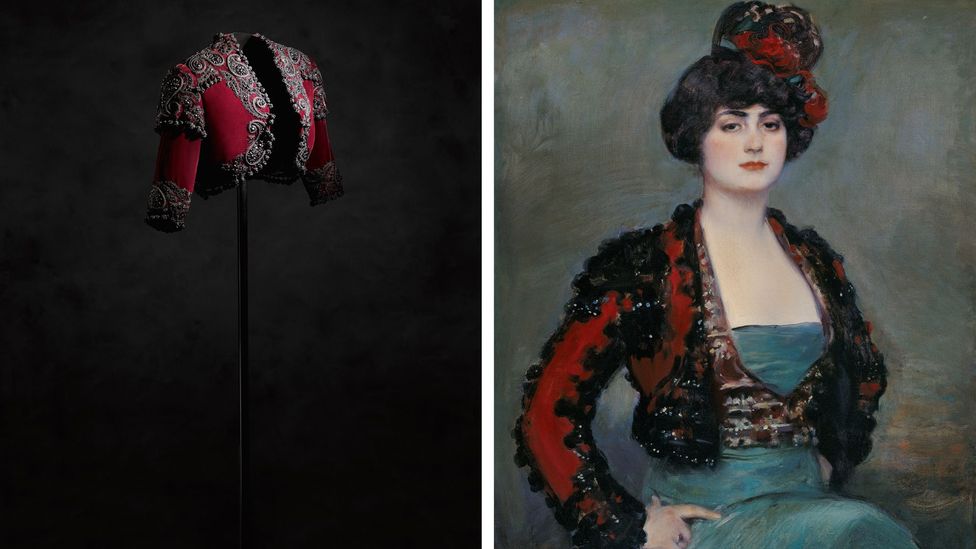
Balenciaga'due south silk-velvet jacket and Julia, 1915, by Carbo (Credit: Jon Cazenave/ Hamish Bowles Collection/ Carmen Thyssen-Bornemisza collection)
Thanks to the patronage of the Marchioness, for whom he designed his showtime gown at the precocious age of 12, Balenciaga was soon able to turn his passion for fashion into a successful career as a couturier in Spain. His illustrious clientele included royalty and aristocracy. However, any references to the fine art he also loved were conspicuous by their absence in the early on stages of his career.
It took the tragedy of the Spanish Civil War, which broke out in 1936, and Balenciaga's subsequent relocation to Paris, to instil in him the desire to evoke the artistic heritage of his land in his designs.
"All the Spanish influence on his couture is from the moment he arrived in Paris. Information technology is in Paris that he misses Spain," says Martínez de la Pera.
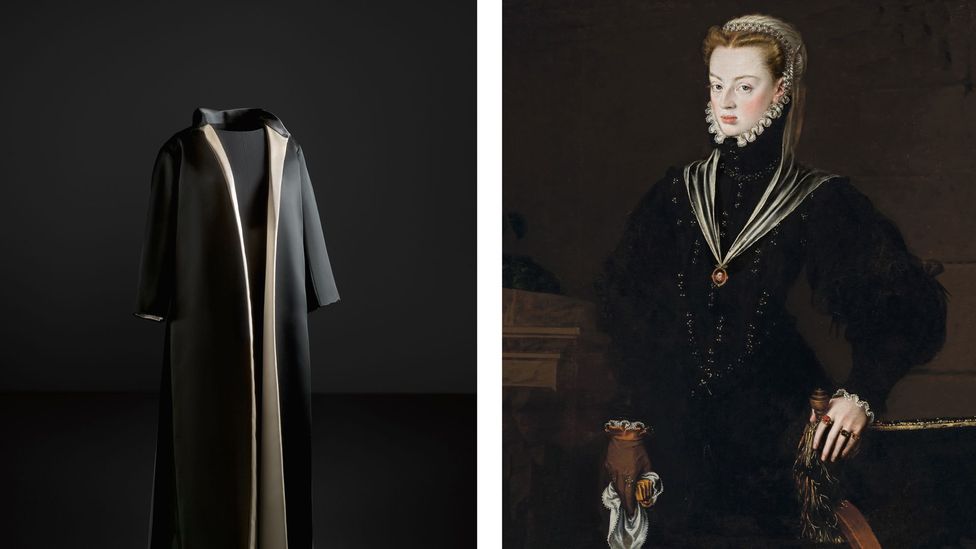
A black satin evening glaze by Balenciaga, 1966, and a portrait of the princess of Portugal by Coello, 1557 (Credit: Jon Cazenave/ Mesuo de Bellas Artes de Bilbao)
His first collection in 1937 included a black "so blackness that information technology hits y'all like a blow. Thick Spanish black, near velvety, a night without stars, which makes the ordinary black seem nearly gray," wrote Harper's Bazaar in awe.
"Blackness is in a way the archetypal colour of Kingdom of spain considering of the court of Phillip 2," explains Martínez de la Pera. The 16th-Century monarch, who ruled over much of Europe, popularised the color throughout his domain, helped in no small role by the portraits of contemporary style icons such as Juana of Austria and Isabelle de Valois. "They were the commencement influencers in the history of fashion. Whatsoever Juana of Republic of austria wore everybody in the other courts wanted to copy,' explains Martínez de la Pera.
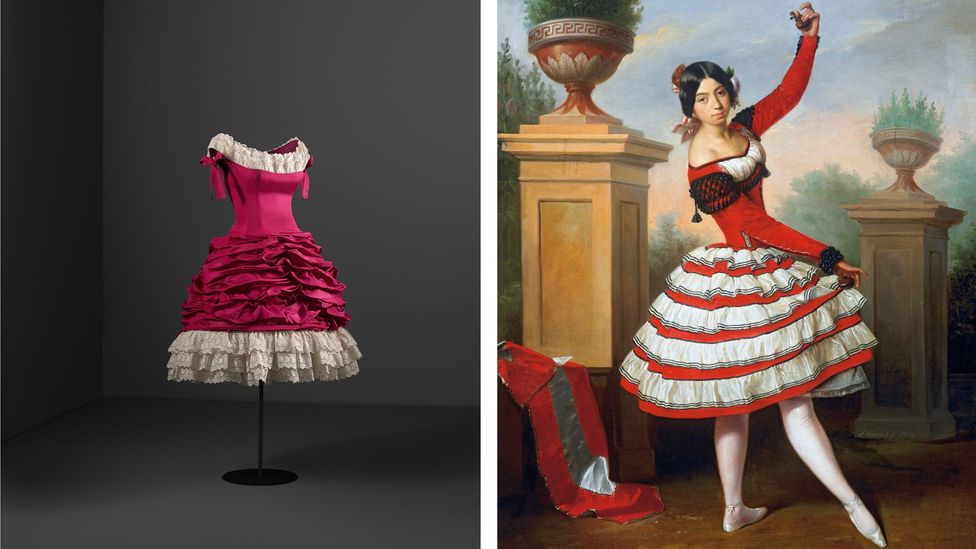
Balenciaga'due south taffeta cocktail dress, 1955, and The Dancer by Josefa Vargas, 1850 (Credit: Museo Nacional Thyssen-Bornemisza, Madrid/ Jon Cazenave)
Balenciaga took the colour and made it resolutely his own. Designs such as a 1943 evening gown in black satin offset past ivory panels subtly referenced those worn by Juana or Isabelle, and proved equally equally desirable. Austerely elegant and resolutely Spanish, they once again made the troubled state the meridian of fashion.
Art of fashion
More ostentatious courtroom fashions besides offered inspiration. Two years later his debut he created a series of gowns directly inspired by Velázquez'south 1650s portraits of the Infanta Margarita Teresa of Austria and her ladies in waiting. The skirts proved and then wide and heavy that a mod version of a farthingale was required to support them.
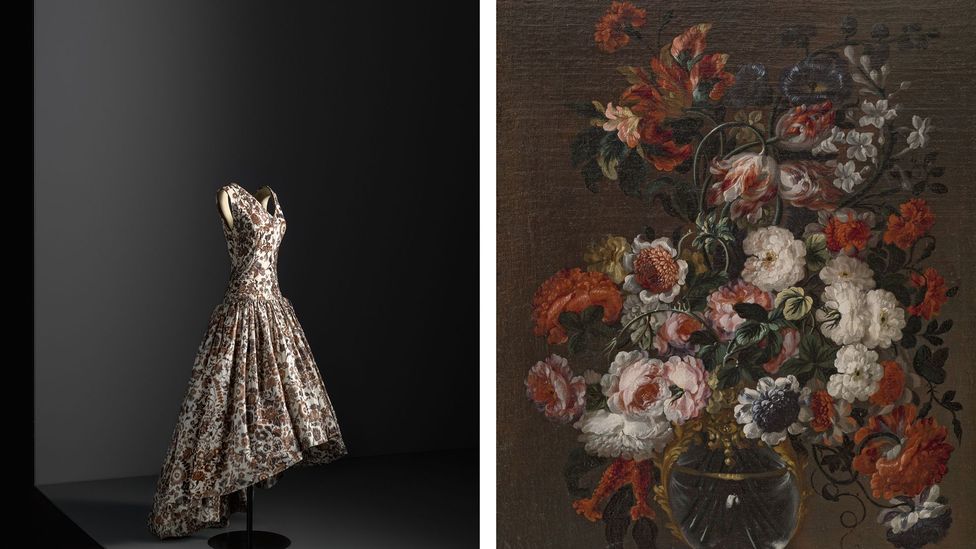
A silk ikat evening gown by Balenciaga and 17th-Century painting Flowers in a Glass Vase past Gabriel de la Corte (Credit: Coleccion de Ines Carvajal/ Gerstenmaier/ Jon Cazenave)
Balenciaga made use of Paris'southward world-form artisans to transform the lavish embroideries seen in portraits past Alonso Sánchez Coello and Juan Pantoja de la Cruz into stunningly contemporary creations in sequins, beading and brocade. Elegant floral bouquets from the still-life painting that was pop at court would also reappear every bit elaborate bloom appliquésouthward on evening coats or embroidered on gowns in silk thread and sequins.
Although Goya'southward unique accept on court and aristocratic painting at the cease of the following century was often less than flattering to his subjects, the artist'due south axiomatic please in the delineation of lace and muslin clearly had an bear upon on Balenciaga's more fragile creations. He "used the most beautiful lace from Calais and Chantilly in order to create these dresses that make y'all experience dressed upwardly but likewise dressed down – it was pure seduction," enthuses Martínez de la Pera.
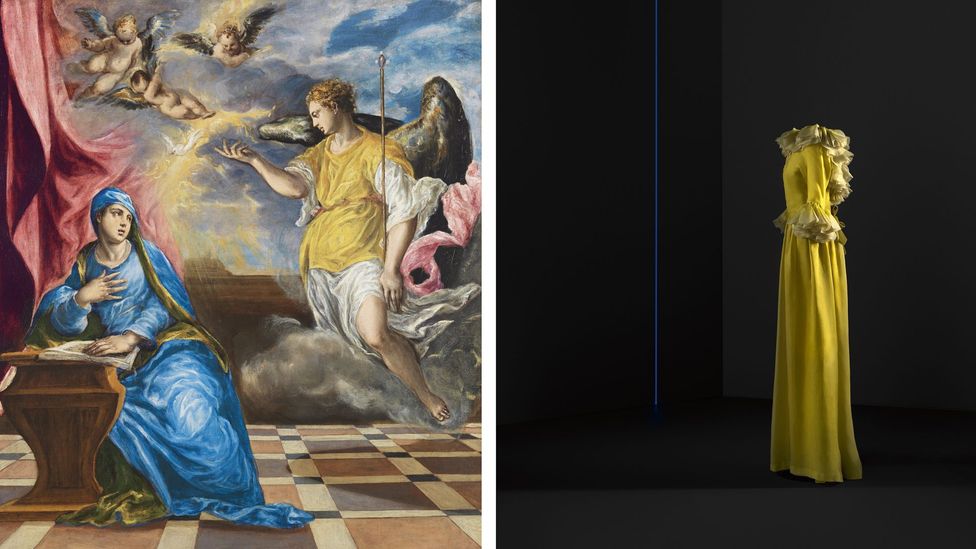
El Greco'south The Announcement, 1576, and Balenciaga's silk organza evening gown, 1968 (Credit: Museo Nacional Thyssen-Bornemisza, Madrid/ Jon Cazenave)
The religious painting of El Greco and Francisco de Zurbarán would have an equally great impact on Balenciaga's aesthetic.
He used the cobalt dejection, lime yellows and dusty pinks in which El Greco dressed his saints to create stunningly elegant evening vesture for a wealthy, earthly elite. The designs acquired a stir among Paris's mode cognoscenti, who were unused to such divine colours.
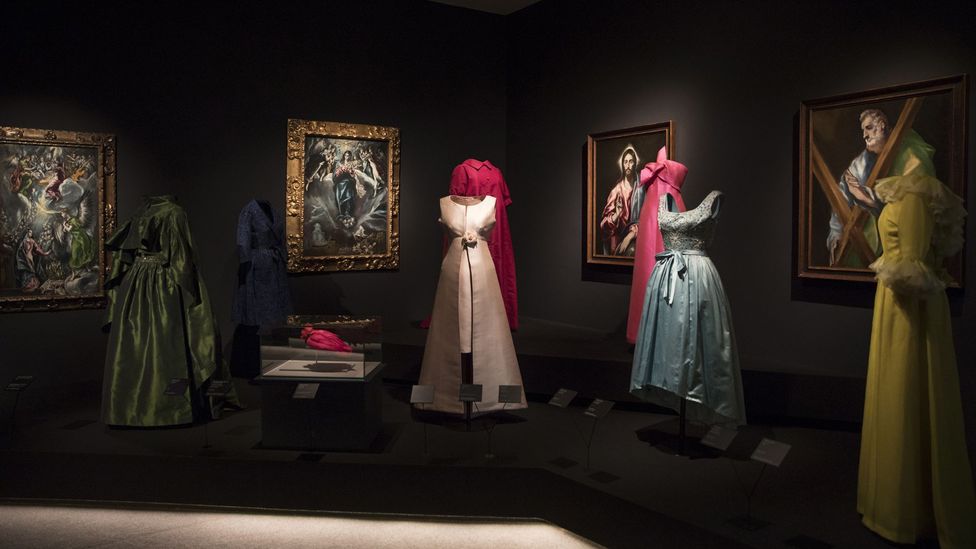
The El Greco room at the exhibition shows how the painter's sumptuous palette influenced the designer (Credit: Museo Nacional Thyssen-Bornemisza, Madrid/ Jon Cazenave)
"Harold Koda, the curator of the Met, said that when Balenciaga arrived in Paris at the stop of the '30s he brought such a beautiful palette of colours that the Parisian girls had to completely change their uniform," says Martínez de le Pera.
In Zurbarán, Balenciaga saw an artist whose attention to detail was as great as his ain. The painter sourced the all-time fabrics and silks from Venice in order to select the perfect combination of colours, patterns and cloth in which to wearing apparel his saints. Zurbarán was so renowned for the mastery in which he replicated the dissimilar cloths and weights of fabrics that Chanel considered him one of the first fashion designers.
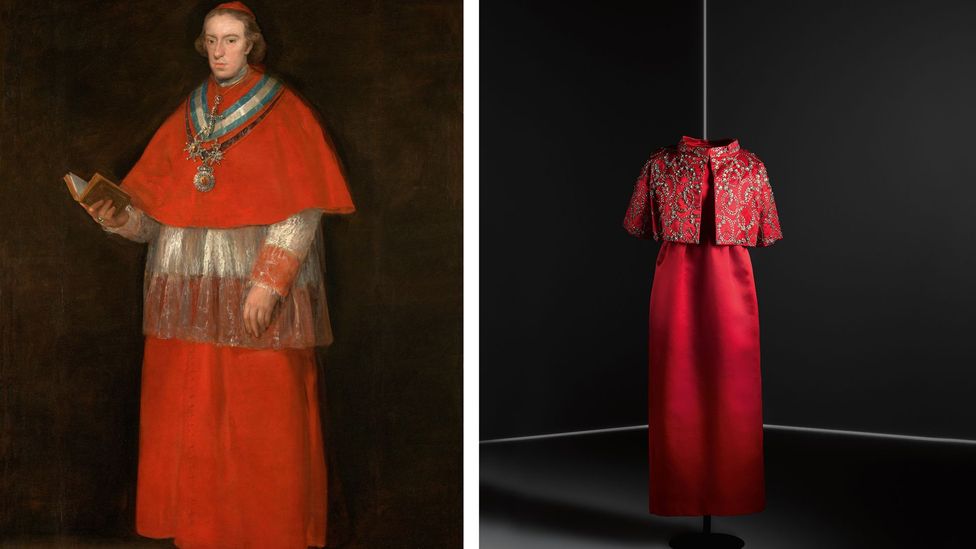
Goya's portrait of Cardinal Luis Maria, 1800, and a Balenciaga outfit in scarlet satin with metallic and ceramic details (Credit: Museo Nacional del Prado, Madrid/ Jon Cazenave)
Balenciaga was especially fatigued to the unproblematic cut and drape of the monks' habits, which inspired his revolutionary architectural styles. "The most iconic wedding dresses of Balenciaga are mixed up with these paintings," says Martínez de la Pera. These include the gown he designed for the Marchioness of Casa Torres'due south ain granddaughter, Fabiola, when she married King Baudouin of the Belgians in 1960. The elegant robe in heavy silk, trimmed with white mink, would become one of the virtually celebrated of his career.
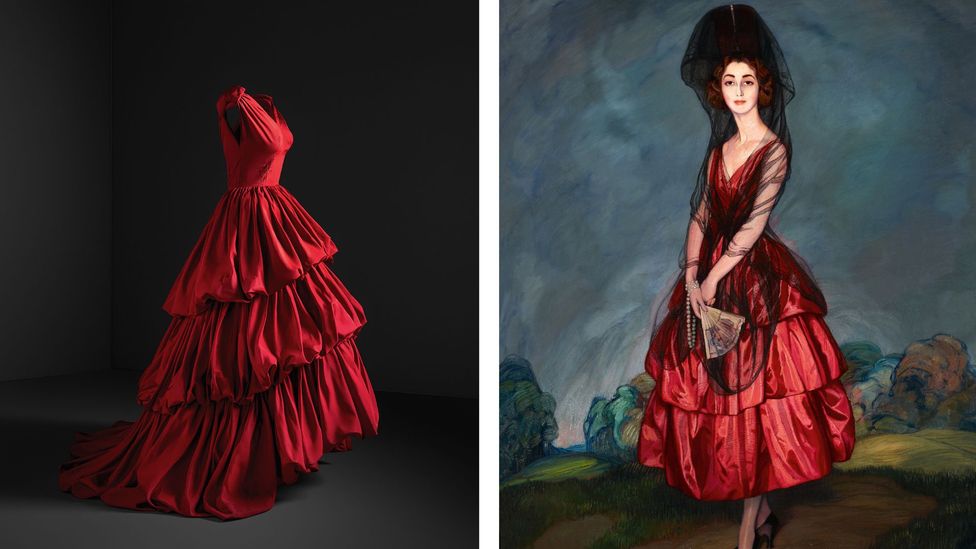
A 1952 taffeta evening gown by Balenciaga and a portrait of Maria del Rosario de Silva, 1921, by Ignacio Zuloaga (Credit: Jon Cazenave/ Fundacion Casa de Alba)
The earthy delights of the flamenco and bullfight whose aesthetic appears in the paintings of 20th-Century artists such as Ramón Casas I Carbó and Balenciaga'southward close friend Ignacio Zuloaga would for some became clichés of Spanish identity. In Balenciaga'southward hands withal they become supremely sophisticated evening attire. A velvet bolero jacket is lavishly embellished with passementerie (elaborate trimmings) and jet beads, while the ripples of a flamenco-inspired gown cascade seductively around the skirt.
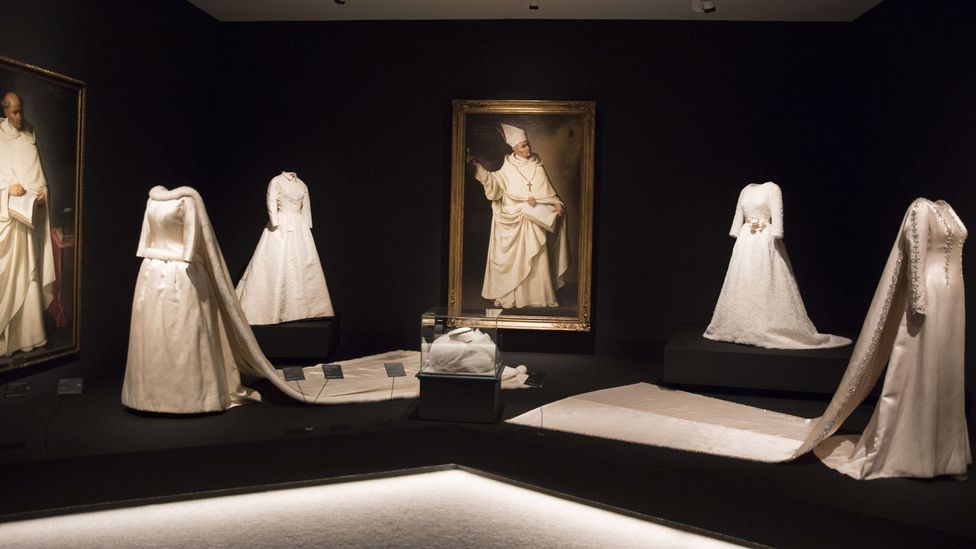
Zurbarán was the greatest painter of textile in Spanish art history, and an influence on Balenciaga (Credit: Museo Nacional Thyssen-Bornemisza, Madrid/ Jon Cazenave)
Although Balenciaga airtight his house in 1968, preferring to bow out while still at the height of his powers, he was persuaded to come out of retirement four years later to dress Full general Franco's granddaughter for her hymeneals to Prince Alfonso of Bourbon.
In its elegant simplicity the gown he created one time over again evoked the linear purity of Zurbarán's friars. The greatest painter of fabric and cloth in the history of Spanish painting joined with the greatest couturier Espana will e'er run into. A fitting finale for a master.
Balenciaga and Castilian Painting is at the Museo Nacional Thyssen-Bornemisza in Madrid until 7 September
If you would like to comment on this story or anything else yous accept seen on BBC Culture, head over to ourFacebook folio or bulletin us onTwitter.
And if y'all liked this story, sign up for the weeklybbc.com features newsletter, called "If You Just Read 6 Things This Week". A handpicked choice of stories from BBC Future, Civilisation, Upper-case letter and Travel, delivered to your inbox every Friday.
Source: https://www.bbc.com/culture/article/20190724-what-inspired-the-master-of-fashion
0 Response to "The Art of Serving God by Alonso De Madrid"
Enregistrer un commentaire